After enough time inside growing organizations, the pattern becomes difficult to ignore. Different industries, different teams, different stages of growth — but eventually, the same operational weight surfaces underneath all of them.
Processes that no longer fit the business they're supporting. Communication gaps nobody fully notices until execution starts slowing down. Workarounds quietly replacing structure.
Good people spending more energy compensating for friction than creating momentum.
Individually, none of it feels large enough to stop everything and rebuild. Together, it changes how the entire business operates. Most companies treat these as separate problems.
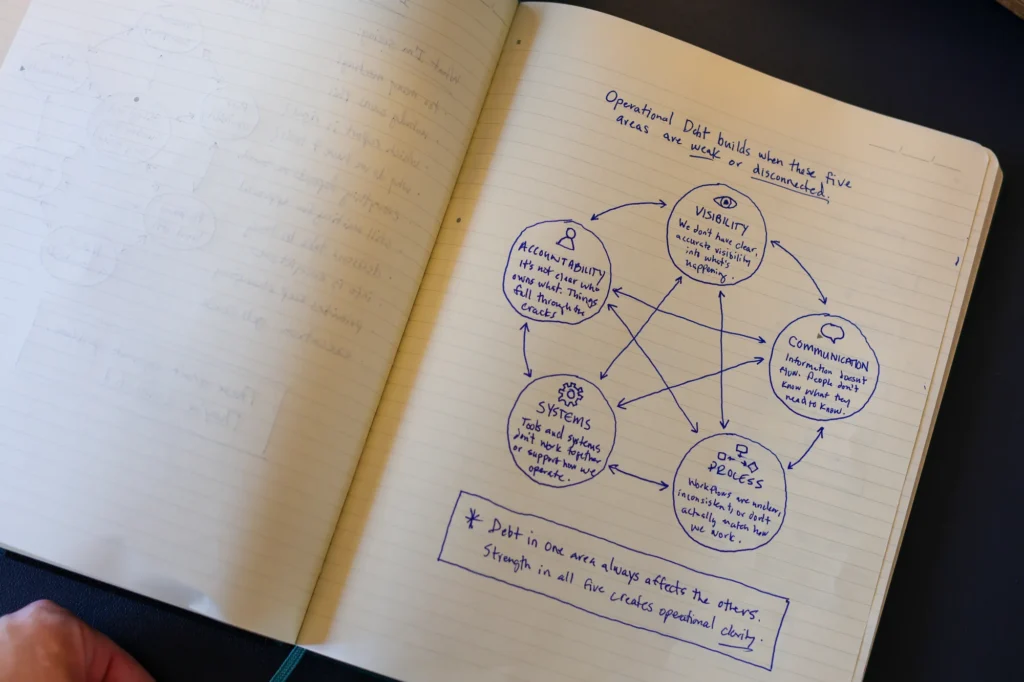
Operational Debt is the accumulation of operational drag that builds when the business evolves faster than the way it operates. Because each layer feeds the others — people, process, systems, communication, visibility — the weight compounds quietly over time.
Businesses rarely lose momentum because of one dramatic collapse. More often, they slowly grow around friction they no longer realize they're carrying.
It accumulates gradually across the business, in patterns that reinforce each other over time. Most organizations are carrying some combination of all five.
Processes that no longer fit the business they're supporting. Communication gaps nobody fully notices until execution starts slowing down. Workarounds quietly replacing structure.
Teams start operating from different assumptions. Leadership spends more time reacting than anticipating.
Slow decisions. Reactive leadership. Strategic blind spots.
Important context gets trapped in conversations instead of moving cleanly through the business. Alignment starts depending on who happened to be in the room.
Follow-up becomes constant because clarity no longer carries forward consistently.
Slow decisions. Reactive leadership. Strategic blind spots.
Processes that once supported the business stop matching the complexity of the organization around them. Workarounds quietly replace structure.
Execution becomes increasingly dependent on individual effort instead of operational consistency.
Operational drag. Rework. Inconsistent execution.
Businesses attempt to solve operational friction through additional tools and platforms. But without operational clarity underneath them, systems multiply complexity instead of reducing it.
Wasted software spend. Duplicate work. Fragile operations.
Leaders carry too much organizational context personally, while high performers quietly compensate for gaps that other systems should address. Execution becomes dependent on individual intervention.
Leadership dependency. Organizational fatigue. Burnout.
Each layer reinforces the others. And because most organizations adapt gradually, the full cost often remains hidden until growth, execution, and trust begin slowing down at the same time.
The goal of the framework is not to create more operational complexity. It's to make the invisible weight inside the business visible enough to resolve clearly.
→
Affects how communication flows across the business
→
Shapes how processes get built and maintained
→
Determines which systems are needed and how
→
Defines what people can realistically be held to
→
Feeds back into visibility, compounding the debt
VerraForge exists to uncover where that operational weight is accumulating, what it is actually costing the business, and what needs to change for momentum to return.
Not every issue requires rebuilding everything. Sometimes a business needs clearer visibility. Sometimes it needs stronger operational structure.
The goal is to help businesses operate with more clarity, more trust, and less unnecessary operational drag.